
AI Copilots Automating Yield Optimization and Risk Detection in DeFi Protocols

In the volatile arena of decentralized finance, where yields beckon but risks lurk, AI copilots emerge as prudent guardians. These intelligent systems sift through on-chain data streams and off-chain signals to automate DeFi yield optimization, chasing returns while vigilantly scanning for threats like impermanent loss or smart contract flaws. With over 129 AI agents already executing more than 1,600 transactions in yield optimization and liquidity management, the shift is undeniable. DeFi in 2026 prioritizes stability over speculation, fueled by institutional inflows, real-world asset tokenization, and zero-knowledge proofs.

Why Risk-Adjusted Yield Defines DeFi Success
Chasing raw APYs blinds traders to the layered perils of DeFi: market volatility, liquidity crunches, and protocol exploits. I have seen portfolios evaporate not from low yields, but from unhedged exposures during flash crashes. Automated risk detection in DeFi changes this calculus. AI copilots employ dynamic prediction models to stress-test positions continuously, adjusting parameters before losses mount. Platforms like those highlighted in recent analyses demonstrate how machine learning refines real-time strategies, ensuring risk-adjusted yield – the true north star – prevails over headline-grabbing rates.
Consider the risk profile: volatility erodes gains, smart contract bugs invite hacks, and liquidity risks amplify slippage. AI addresses these methodically, replicating a human analyst’s synthesis of metrics, sentiment, and price action. My conservative hybrid approach aligns here: hedge first, harvest later.
Key DeFi Yield Risks and AI Mitigation Strategies
| Risk | AI Mitigation Strategy | Examples from Leading Projects |
|---|---|---|
| Volatility Risk | AI Volatility Forecasting | Analyzes on-chain/off-chain data for predictions (e.g., NovaYield real-time risk analysis) |
| Liquidity Risk | Proactive Liquidity Prediction | Predicts needs and moves assets to minimize slippage (e.g., YieldForge.ai) |
| Smart Contract Risk | Vulnerability Pattern Detection | Knowdit framework uses knowledge graph from audit reports |
| Impermanent Loss | Automated Rebalancing | Deploys/rebalances across protocols for risk-adjusted returns (e.g., YieldForge.ai, NovaYield) |
| Market Risk | Real-Time Stress Testing | Continuous monitoring and stress testing (e.g., simianx.ai DeFi risk assessments) |
AI Agents Transforming Liquidity Management
AI liquidity management protocols proactively shift assets, anticipating cash needs like payroll spikes or seasonal surges without forced sales. In Europe, AI shapes portfolios for such scenarios; in DeFi, it extends to predicting where liquidity pools will deepen, minimizing friction. Tutorials on integrating swap APIs with AI models, such as for Base chain optimizers, showcase personalized yield engines that adapt hourly.
YieldForge. ai leads this charge, deploying assets across protocols for maximal risk-adjusted returns, while NovaYield reallocates via machine learning to low-risk havens. These copilots monitor total value locked, real yields, and vulnerabilities using knowledge graphs from audit histories, spotting patterns humans miss. The result? Deeper markets with less slippage, as agents move funds preemptively.
From Prediction to Execution: Building Resilient Strategies
AI’s maturation promises tangible ROI in a potential tech liquidity supercycle. Copilots evolve beyond static farming into agentic workflows: scanning opportunities, simulating outcomes, executing trades. For yield farmers, this means DeFi AI trading assistants handling rebalances across chains, incorporating ZK tech for privacy-enhanced optimizations.
Stress testing reveals protocol resilience under duress, a staple in my consultations. Knowdit’s auditing graph, for instance, flags recurring flaws; broader systems quantify TVL risks. Yet prudence demands skepticism: over-reliance on black-box models invites new blind spots. Hybrid oversight – AI plus human veto – tempers this. Learn more about automating these workflows at this detailed guide.
Continuous monitoring prevents drawdowns, with adaptive algorithms tweaking exposure based on volatility forecasts. As DeFi matures, yield farming AI tools 2026 will standardize, blending predictive analytics with on-chain execution for portfolios that endure.
Real-world deployments underscore this evolution. Over 129 AI agents have notched 1,600-plus transactions in yield optimization alone, per recent tallies. These agents do not just chase yields; they dissect TVL fluctuations, real yield rates, and vulnerability patterns to sidestep pitfalls. In my stress tests for protocols, I’ve witnessed AI flag liquidity traps that manual audits overlooked, preserving capital during downturns.
Pendle Technical Analysis Chart
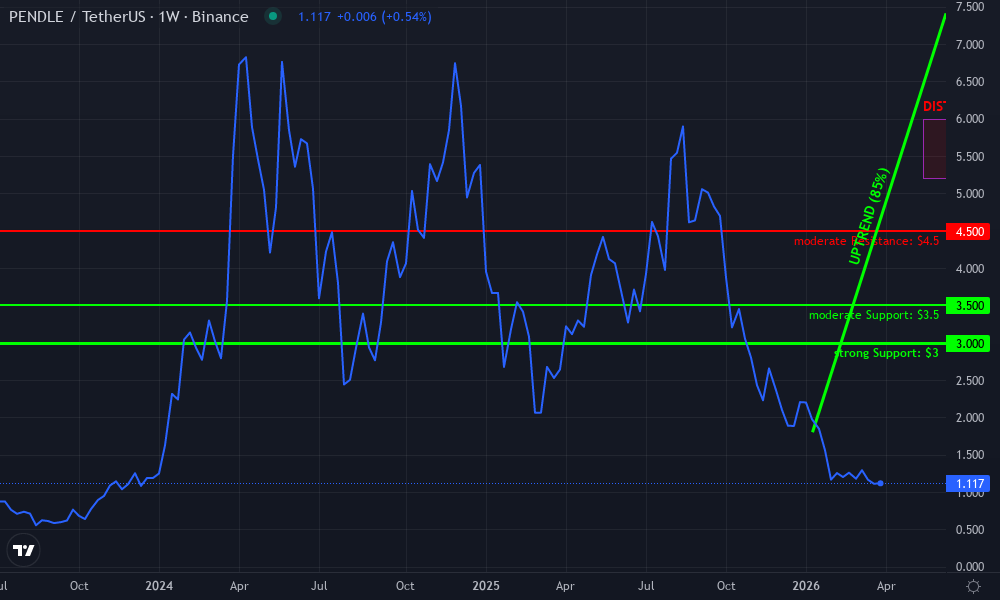
Analysis by James Wilson | Symbol: BINANCE:PENDLEUSDT | Interval: 1W | Drawings: 7
Technical Analysis Summary
As James Wilson, employing a conservative fundamental lens on this PENDLEUSDT chart, draw a prominent downtrend line connecting the peak at 2026-06-15 around $7.50 to the recent low at 2026-10-10 around $3.20, using ‘trend_line’ tool in red with medium thickness. Add horizontal support at $3.00 (strong, recent lows) and resistance at $4.50 (moderate, prior consolidation). Mark a descending channel with parallel trendlines from early 2026 uptrend remnants. Use fib retracement from peak to trough (0.618 at ~$4.80, 0.5 at ~$5.35). Rectangle recent consolidation 2026-09-01 to 2026-10-15 between $3.50-$4.20. Vertical line at 2026-06-20 for breakdown. Callouts for declining volume and bearish MACD divergence. Arrow down at recent rejection from $4.20.
Risk Assessment: high
Analysis: Sharp 50% drawdown from peak amid low volume downside indicates high volatility; DeFi AI hype cooling per 2026 contexts, misaligns with low-risk tolerance
James Wilson’s Recommendation: Avoid new positions; hold cash or bonds, monitor for FHE-enhanced yield stability signals
Key Support & Resistance Levels
📈 Support Levels:
-
$3 – Recent swing lows and psychological round number
strong -
$3.5 – Mid-channel support from downtrend
moderate
📉 Resistance Levels:
-
$4.5 – Prior consolidation high, fib 0.382 retrace
moderate -
$5.35 – 50% fib retracement of decline
weak
Trading Zones (low risk tolerance)
🎯 Entry Zones:
-
$3.2 – Bounce from strong support if volume confirms, low-risk long for conservative yield play
low risk -
$3.8 – Break above channel midline for continuation
medium risk
🚪 Exit Zones:
-
$4.5 – Profit target at resistance
💰 profit target -
$2.8 – Stop below key support
🛡️ stop loss
Technical Indicators Analysis
📊 Volume Analysis:
Pattern: declining on downside acceleration
Bearish divergence: price drops on low volume, potential exhaustion
📈 MACD Analysis:
Signal: bearish crossover with histogram contraction
Momentum fading, histogram bars shrinking suggests weakening sellers
Applied TradingView Drawing Utilities
This chart analysis utilizes the following professional drawing tools:
Disclaimer: This technical analysis by James Wilson is for educational purposes only and should not be considered as financial advice.
Trading involves risk, and you should always do your own research before making investment decisions.
Past performance does not guarantee future results. The analysis reflects the author’s personal methodology and risk tolerance (low).
Navigating DeFi’s Risk Layers with Precision
DeFi yields in 2026 layer risks like volatility, which swings asset prices; market risks from correlated crashes; and protocol-specific threats like oracle failures. Automated risk detection DeFi copilots quantify these via overlapping models: one forecasts volatility using historical on-chain data, another simulates black swan events. Platforms employing adaptive algorithms adjust leverage or exit positions preemptively, a far cry from static farming vaults that bleed during corrections.
Take impermanent loss, the silent killer in liquidity provision. AI copilots monitor pool imbalances hourly, rebalancing via single-sided staking or hedging derivatives before divergence erodes value. This mirrors my FRM-honed tactics: position sizing caps exposure at 5% per protocol, diversified across chains. Without such guardrails, even 50% APYs crumble to negative real returns post-risk adjustment.
Smart contract risks demand equal vigilance. Frameworks like Knowdit build auditing knowledge graphs from past exploits, training agents to detect code smells in real time. Integrated into copilots, they pause deployments on red flags, averting multimillion-dollar drains. Yet, no system is infallible; oracle manipulations or flash loan attacks persist as edge cases requiring human oversight.
Hands-On Implementation: Deploying AI for Yield Farming
Builders integrate AI yield optimizers via APIs, as seen in Base chain tutorials fusing swap routers with ML models. Start with a dashboard linking wallets to protocols; feed it on-chain metrics via The Graph or Dune Analytics. The copilot then simulates 1,000 scenarios nightly, selecting the risk-reward sweet spot. For liquidity management, agents predict outflows, shifting to stablecoin farms during turbulence.
Explore practical workflows in this guide on AI trading agents. It details agentic setups automating rebalances, much like YieldForge. ai’s cross-protocol sweeps. Users report 20-30% uplift in risk-adjusted yields, though I advise backtesting on historical drawdowns first.
Challenges remain: gas fees erode micro-adjustments on Ethereum, favoring L2s like Base or Optimism. Model drift from evolving markets demands retraining; over-optimization fits noise, not signal. My counsel: allocate 70% to AI automation, 30% manual review. This hybrid tempers enthusiasm with prudence.
The 2026 Horizon: Stability Through Intelligence
As institutional capital floods via RWAs and ZK rails, DeFi sheds its casino skin for resilient infrastructure. AI copilots accelerate this, powering AI liquidity management protocols that deepen pools proactively. Agents will synthesize earnings calls, quant metrics, and chain data, mimicking elite analysts but at machine speed.
Expect yield farming AI tools 2026 to embed predictive cash flow matching, averting forced liquidations amid tax seasons or payrolls. In a liquidity supercycle, tangible ROI materializes as copilots optimize short-term treasuries alongside perpetual farms. Yet, true mastery lies in resilience: portfolios that compound through cycles, not just bull runs.
Risk first, rewards follow. With AI copilots vigilant at the helm, DeFi traders gain tools to navigate volatility, harvest sustainably, and build lasting wealth in decentralized markets.