
Choose an agent framework
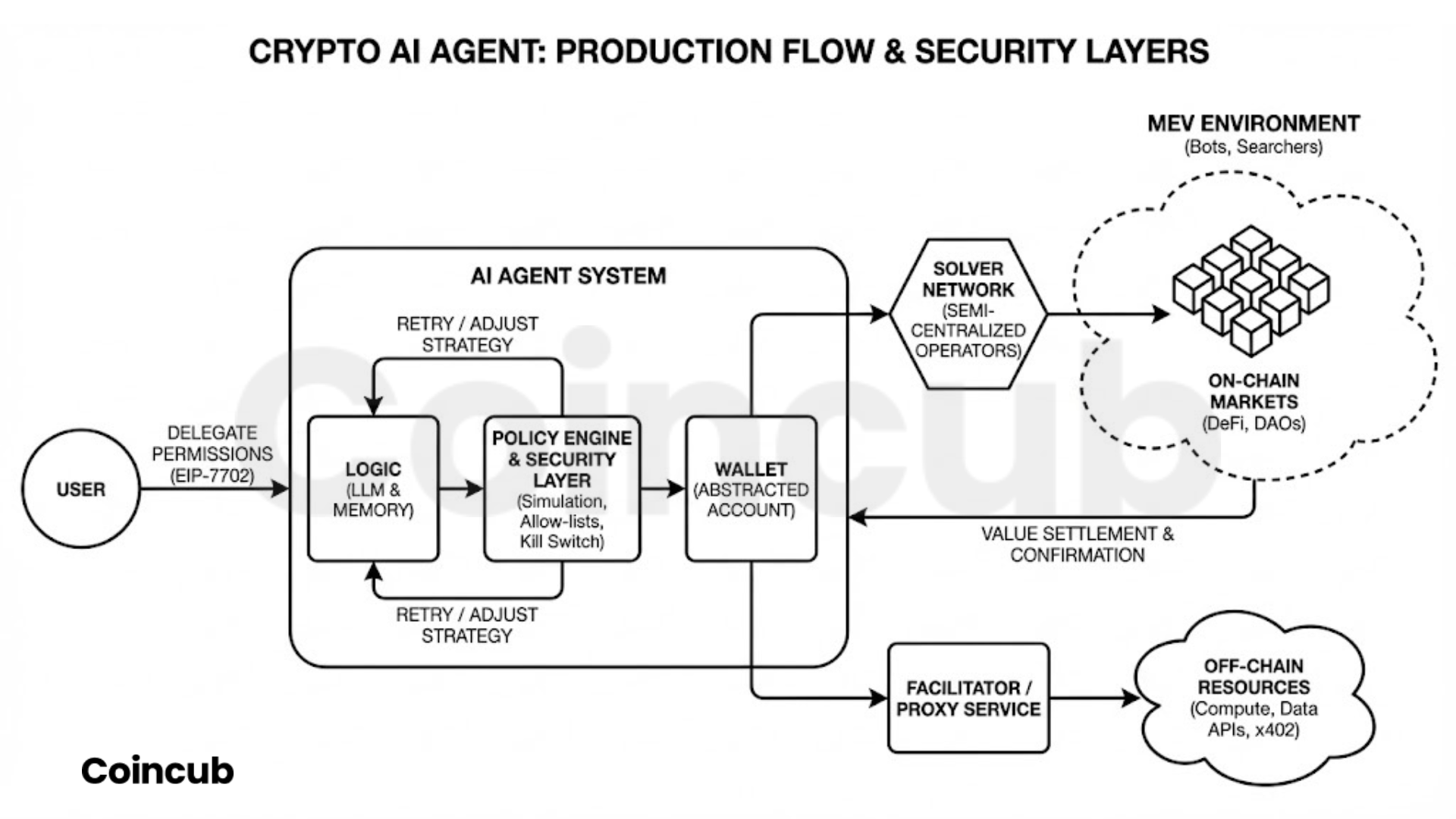
Selecting the right infrastructure determines whether your AI agent executes trades autonomously or stalls on gas fees. In 2026, the market has consolidated around two primary execution models: intent-centric solvers and account abstraction frameworks like EIP-7702. Your choice depends on whether you prioritize execution speed or developer control.
Intent-centric frameworks allow users to declare a desired outcome, such as "swap ETH for USDC at the best rate," while off-chain solvers compete to fulfill the request. This model abstracts away complex transaction routing but introduces reliance on solver reputation. Conversely, EIP-7702 enables smart contracts to act as signers, allowing AI agents to manage permissions and execute logic directly on-chain with lower overhead than traditional ERC-4337 accounts.
The following comparison outlines the core differences between these approaches to help you align the framework with your security and automation requirements.
| Framework | Security Model | Supported Chains | Automation Depth |
|---|---|---|---|
| Intent-Centric Solvers | Solver reputation & slashing | Multi-chain (L2s) | High (full execution) |
| EIP-7702 | On-chain permissioning | EVM-compatible | Medium (logic execution) |
| ERC-4337 | Account abstraction | Widespread | Medium (session keys) |
| Orbs Agentic | Distributed solver network | Multi-chain | High (DeFi native) |
Connect and secure the wallet
An AI agent cannot act without a digital key, but handing over full control is the fastest way to drain an account. The goal is to establish a connection that allows the agent to execute specific DeFi transactions—like swapping tokens or providing liquidity—while strictly limiting its ability to move funds out of the ecosystem. This section walks through the technical setup of connecting an AI agent to a DeFi wallet, emphasizing security constraints and permission scoping.
Never connect an AI agent to your primary holdings wallet. Create a new, empty wallet specifically for automation tasks. This "hot wallet" will hold only the capital required for the agent’s immediate operations. If the agent is compromised or makes a critical error, the damage is contained to this isolated account, leaving your main assets untouched.

Transfer only the amount of cryptocurrency the agent needs to function. For example, if the agent manages a $500 liquidity position, fund the wallet with exactly that amount plus a small buffer for gas fees. Avoid over-funding; excess liquidity sitting in an automated wallet is unnecessary risk. Treat this balance as a "burn rate" that should be monitored regularly.
Most AI agent frameworks allow you to define a "whitelist" of approved smart contracts. Before connecting, identify the specific DeFi protocols the agent will interact with (e.g., Uniswap, Aave) and add their contract addresses to the allowlist. This prevents the agent from accidentally interacting with malicious or phishing contracts that mimic legitimate DeFi interfaces.

Implement hard limits on transaction size and frequency. Configure the agent to reject any single swap exceeding a set percentage of the wallet balance. Additionally, set a "circuit breaker" that pauses all activity if the wallet’s total value drops by a certain threshold (e.g., 10%) within a short period. This provides a safety net against rapid market volatility or exploitative smart contract behavior.
Before enabling full automation, execute a manual test transaction through the agent’s interface. Send a minimal amount to a testnet or a low-value mainnet transaction to verify that the agent can sign, broadcast, and confirm transactions correctly. Check the transaction hash on a block explorer to ensure the data payload matches your intended action.
Once the connection is live, treat the wallet as a living system. Regularly review the agent’s activity logs and adjust permission scopes as your strategy evolves. The most secure AI agent is one that can do only what you explicitly programmed it to do, nothing more.
Define yield farming parameters
Configuring an AI agent for autonomous yield farming requires precise input on risk tolerance, asset selection, and rebalancing triggers. Unlike manual farming, where you monitor positions daily, an autonomous agent needs strict guardrails to prevent catastrophic losses during market volatility or smart contract exploits.
Start by defining your risk tolerance. This setting dictates how the agent balances yield against potential downside. Conservative profiles prioritize established protocols with long track records and multiple audits, accepting lower APYs for stability. Aggressive profiles may chase high-yield opportunities on newer chains, but this significantly increases exposure to impermanent loss and rug pulls. Most official sources recommend starting with a moderate risk profile to test the agent’s execution logic before scaling up.
Next, select your asset pool. You must specify which tokens the agent is allowed to trade and provide liquidity with. Common pairs include stablecoin-to-stablecoin (lower risk, lower yield) or blue-chip crypto pairs like ETH/USDC. Avoid exposing the agent to illiquid or low-market-cap tokens unless you have explicitly verified the contract’s security. The agent should only interact with protocols that have undergone formal audits by reputable firms.
Finally, set rebalancing and stop-loss parameters. Define the threshold at which the agent should withdraw funds. For example, if a token’s price drops by 10% relative to its pair, should the agent exit immediately to preserve capital, or hold through the dip? These parameters act as the agent’s "brakes." Without them, an autonomous system might compound losses during a flash crash. Always verify that the agent’s smart contract integration allows for manual override in case of emergency.
As AI agents move from experimental tools to active financial operators in 2026, the precision of these initial parameters determines whether the system acts as a profitable optimizer or a liability. Treat the configuration phase as a security audit of your own strategy.
Run a simulation test
Before deploying capital, you must validate your DeFi AI agent in a controlled environment. Testnets mimic mainnet conditions without financial risk, allowing you to catch logic errors, gas estimation failures, and security vulnerabilities early. Treating a testnet deployment as a final checkpoint prevents costly exploits that simulation could have caught.
1. Select a compatible testnet
Choose a testnet that mirrors the target mainnet’s EVM compatibility. Ethereum’s Sepolia or Holesky are standard for Ethereum-based DeFi protocols. For L2 solutions, use their respective testnets (e.g., Arbitrum Sepolia or Optimism Sepolia). Ensure your wallet is funded with testnet tokens to cover gas fees. If your agent interacts with specific bridges or oracles, verify they are active on the chosen testnet.
2. Deploy the agent contract
Compile your smart contract code using the same configuration intended for mainnet. Deploy the contract to the testnet using your development environment (Hardhat, Foundry, or Remix). Verify the deployment address and record it. This step confirms that your code compiles correctly and that the contract initializes with the expected parameters, such as wallet addresses or token allowances.
3. Execute simulated transactions
Trigger your AI agent’s core functions using testnet data. If your agent monitors price feeds, simulate oracle updates or use testnet-specific oracle contracts. Execute trades, liquidity additions, or yield optimizations. Monitor the transaction receipts closely. Check for reverts, unexpected gas usage, or incorrect state changes. This phase tests the agent’s decision-making logic against real-world blockchain constraints.
4. Audit logs and error handling
Review the agent’s logs and error handling mechanisms. Did the agent correctly identify and handle edge cases, such as insufficient liquidity or failed transactions? Test negative scenarios: what happens if an oracle price is stale or a trade fails? Robust error handling is critical for AI agents that operate autonomously. Ensure the agent pauses or alerts human operators when anomalies occur, rather than executing blindly.
5. Validate security and permissions
Perform a final security check on the testnet deployment. Ensure that only authorized addresses can trigger critical functions. Verify that the agent cannot drain funds due to permission misconfigurations. Use testnet-specific security tools or audits if available. Once you are confident that the agent behaves as expected and handles errors gracefully, you can proceed to mainnet deployment with significantly reduced risk.
Monitor and adjust strategies
Autonomous agents execute trades without human intervention, but market conditions shift faster than any static algorithm can predict. Monitoring your DeFi AI agent is not about watching every second; it is about verifying that the agent’s logic aligns with current market realities. When volatility spikes or liquidity dries up, automated systems may continue executing based on outdated parameters, leading to slippage or unexpected losses.
Start by reviewing the agent’s execution logs daily. Look for patterns in failed transactions or unusual gas spending. If the agent is interacting with multiple protocols, ensure that each smart contract interaction is completing as intended. Sudden changes in transaction failure rates often signal that a protocol has updated its interface or that a liquidity pool has become too thin for the agent’s order size.
Parameter adjustments should be made proactively, not reactively. If you notice the agent is over-exposing capital during low-volume periods, reduce the maximum trade size or tighten the stop-loss thresholds. Conversely, if the agent is missing profitable opportunities due to overly conservative settings, you might increase the risk tolerance slightly. The goal is to keep the agent’s behavior within the bounds of your risk appetite.
Manual overrides are your safety net. Most DeFi AI frameworks allow you to pause execution instantly. If you detect a potential exploit or a significant market anomaly, use the pause function immediately. Do not wait for the agent to self-correct. Once the situation stabilizes, review the logs to understand why the agent reacted (or failed to react) as expected, then resume with adjusted parameters.
-
Verify transaction success rates across all connected protocols.
-
Check for unusual gas fees or failed contract interactions.
-
Review open positions against current market liquidity.
-
Confirm that stop-loss and take-profit levels are still aligned with your risk tolerance.
-
Pause execution immediately if any anomalous behavior is detected.
Common AI Agent Mistakes
DeFi AI agents execute transactions autonomously, meaning a configuration error can drain a wallet before you notice. Avoid these three frequent pitfalls to protect your capital.
Over-Permitting Access
Many users grant AI agents unlimited approval to spend their tokens. This is equivalent to handing over your keys. Instead, use token-specific allowances or time-limited approvals. Only grant the minimum permissions required for the specific strategy you are running.
Ignoring Smart Contract Risks
An AI agent is only as safe as the contracts it interacts with. If the underlying protocol is compromised, the agent will execute the exploit automatically. Always audit the smart contracts the agent connects to. Do not trust unverified or new protocols with automated funds.
Lack of Circuit Breakers
Without safeguards, an agent can continue trading during a market crash or a bug. Implement circuit breakers that pause operations if losses exceed a certain threshold or if transaction gas prices spike abnormally. This manual override is your final line of defense.

No comments yet. Be the first to share your thoughts!